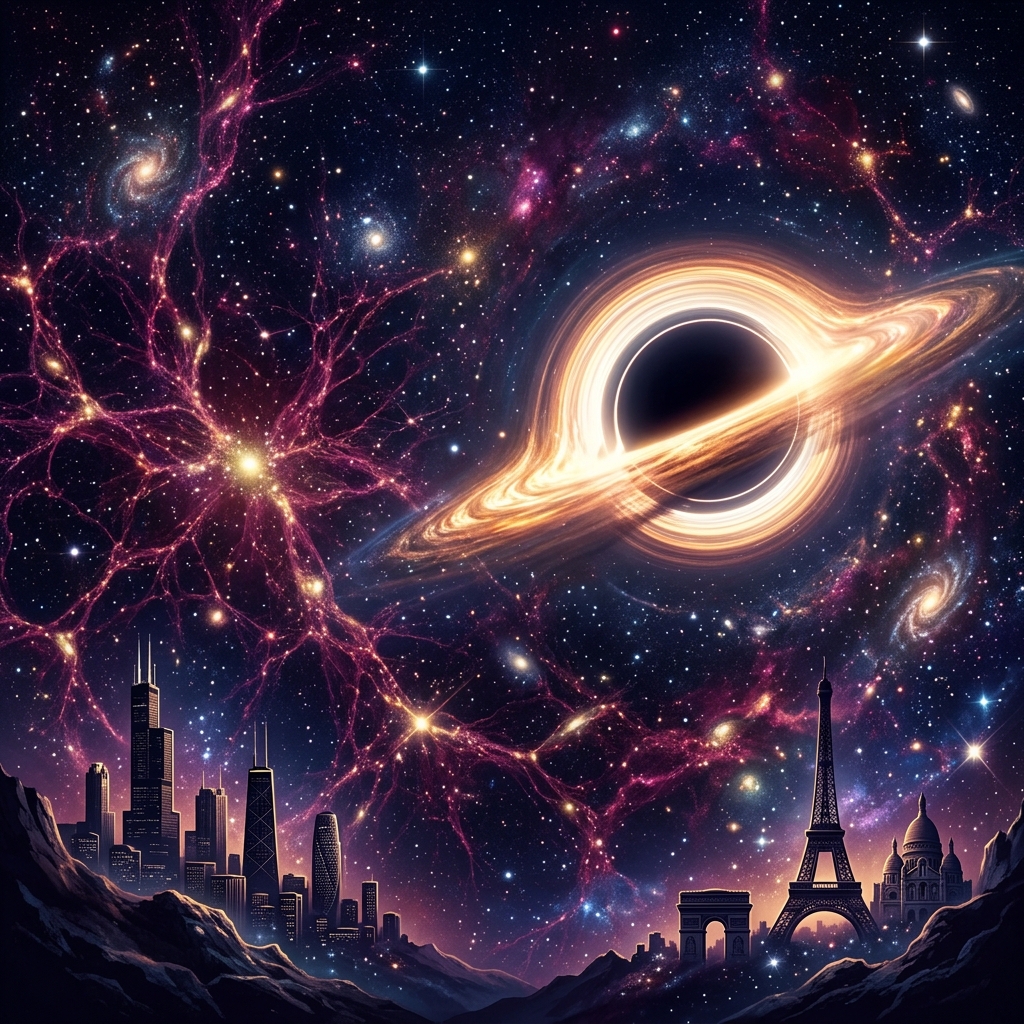
Uniting the global computational astrophysics community with leading observers to resolve the most formidable physical challenges of galaxy assembly and feedback across cosmic time.
The rapid escalation of observational capabilities, spearheaded by the James Webb Space Telescope (JWST) and complemented by advanced ground-based facilities, has revealed an early Universe of unexpected complexity. From the birth of the first stellar systems at Cosmic Dawn (z > 10) to the peak epoch of star formation and supermassive black hole growth at Cosmic Noon (z ~ 2), contemporary models are being challenged at every scale. Unraveling the physics behind these discoveries requires a rigorous, multiscale framework that can only be built through state-of-the-art numerical simulations.
The **Deepdish-Baguette** conference serves as a premier international forum designed to bridge the gap between global numerical modelers and observational pioneers. By contrasting advanced computational techniques—such as star-by-star resolution, turbulent cloud modeling, live dust dynamics, and anisotropic cosmic ray transport—with the latest observational constraints, this meeting aims to address the most critical questions in galaxy assembly. The conference name symbolizes the collaboration between the computational cosmology heritage of the University of Chicago and the rich astrophysical simulation groups of Paris and broader Europe. This event is proudly supported by the France And Chicago Collaborating in The Sciences (FACCTS) grant.
Resolving individual stars and stellar feedback inside global galaxy simulations to capture cluster formation, IMF sampling, and gas chemistry on parsec scales.
Modeling turbulent Giant Molecular Clouds (GMCs) at sub-parsec scales to study radiation pressure, wind driving, early stellar feedback, and cloud disruption.
Implementing active dust grains: tracing dust formation, stellar source enrichment, grain growth/destruction, and gas-dust dynamics.
Modeling cosmic ray transport, anisotropic diffusion, and acceleration to investigate their feedback role in galaxy formation and the ISM.
Simulating the multiphase circumgalactic medium (CGM), including metal-line cooling, cold gas accretion streams, and galactic wind recycling.
Modeling black hole seed formation, hyper-Eddington accretion, and mechanical/radiative active galactic nuclei (AGN) feedback at high redshift.
Simulating radiation transport on cosmological scales, the contribution of early galaxies, and the ionization state of the IGM.
Pushing computational boundaries with next-generation grid/particle solvers, GPU-accelerated codes, and novel AMR algorithms.
The detailed daily schedule and list of accepted talks will be finalized and posted here in early 2027.
The Scientific Organizing Committee is currently structuring the daily sessions. The final program will blend scene-setting keynotes from observational pioneers with selected oral presentations covering our numerical themes.
World-class astrophysicists leading observational and theoretical studies of the early universe.
Our list of invited keynote and session speakers is currently being finalized by the Scientific Organizing Committee. We will announce the full roster of observers and computational modelers in early 2027.
The conference will take place at the brand new University of Chicago Boyer Center in Paris, a hub for international research and education.
Portals will activate on August 1, 2026. Abstract submissions close on October 31, 2026.
The registration portal and abstract submission forms are currently locked. Submissions will open on **August 1, 2026** at 00:00 UTC.
The scholars coordinating the scientific program and hosting logistics.